
Harry Belafonte, barrier-smashing entertainer and activist, dies at 96
A star after ‘The Banana Boat Song,’ he became a key ally to the Rev. Martin Luther King Jr. during the civil rights
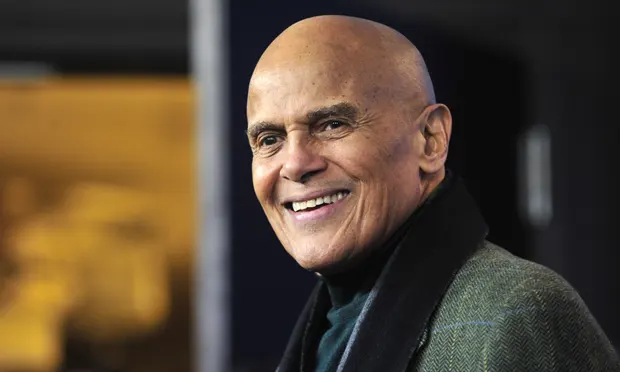
Harry Belafonte, the singer whose dynamic a cappella shout of “Day-O!” from “The Banana Boat Song” and other music from world folk traditions propelled him to international stardom, and who used his entertainment fortune to help bankroll the civil rights movement at home and human rights causes worldwide, died April 25 at his home in Manhattan. He was 96.
The cause was congestive heart failure, said his spokesman Ken Sunshine.
Mr. Belafonte was born to Jamaican immigrants, grew up in poverty in Depression-era Harlem and became a major Black crossover success in popular music. He went on to smash a series of barriers during five decades as a movie, TV and stage star. His artistic and humanitarian work frequently overlapped, reflecting his belief that “the role of art isn’t just to show life as it is but to show life as it should be.”
A confidant of the Rev. Martin Luther King Jr., Mr. Belafonte spent years as a liaison between the civil rights movement and the entertainment capitals of Hollywood and New York City. He also used his clout to promote the anti-apartheid struggle in South Africa and famine relief through efforts such as the “We Are the World” recording and concerts in 1985.
Mr. Belafonte once said he spent his life “in a constant state of rebellion.” He sharply rebuked American presidents Democrats and Republicans as not doing enough to end squalor in the United States or end conflicts abroad. He criticized George W. Bush’s White House over the 2003 invasion of Iraq and created a furor when he likened Colin Powell, also of Jamaican parentage and secretary of state at the time, to a “house slave.”
He also was critical of the nation’s first African American president, saying that “for all of his smoothness and intellect, Barack Obama seems to lack a fundamental empathy with the dispossessed, be they White or Black.” Providing fuel to his detractors, Mr. Belafonte associated himself with oppressive left-wing leaders such as Fidel Castro of Cuba and Hugo Chávez of Venezuela.
“I wasn’t an artist who’d become an activist,” Mr. Belafonte liked to say. “I was an activist who’d become an artist.”
Harry Belafonte, a multi-talented entertainer and activist who broke barriers in the industry and was instrumental in the civil rights movement, has died at 96. (Video: Jayne Orenstein, Drea Cornejo/The Washington Post)
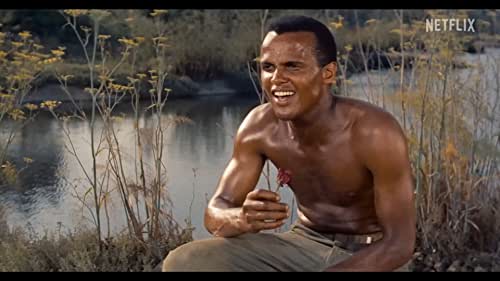
Virile and sinewy, with a rakish smile and husky voice, Mr. Belafonte had burst to fame in the 1950s with a bold sensuality that flouted sexual taboos in an era of racial segregation. In concerts and on TV, he was presented to audiences as a snake-hipped charmer, wearing unbuttoned shirts that clung to the contours of his physique.
A year after the film industry’s Production Code lifted its ban on showing interracial sexual relationships in movies, Mr. Belafonte played the love interest of the White actress Joan Fontaine in “Island in the Sun” (1957). In that potboiler, a film he later disavowed as too tame, he was publicized as the first Black matinee idol for mainstream audiences.
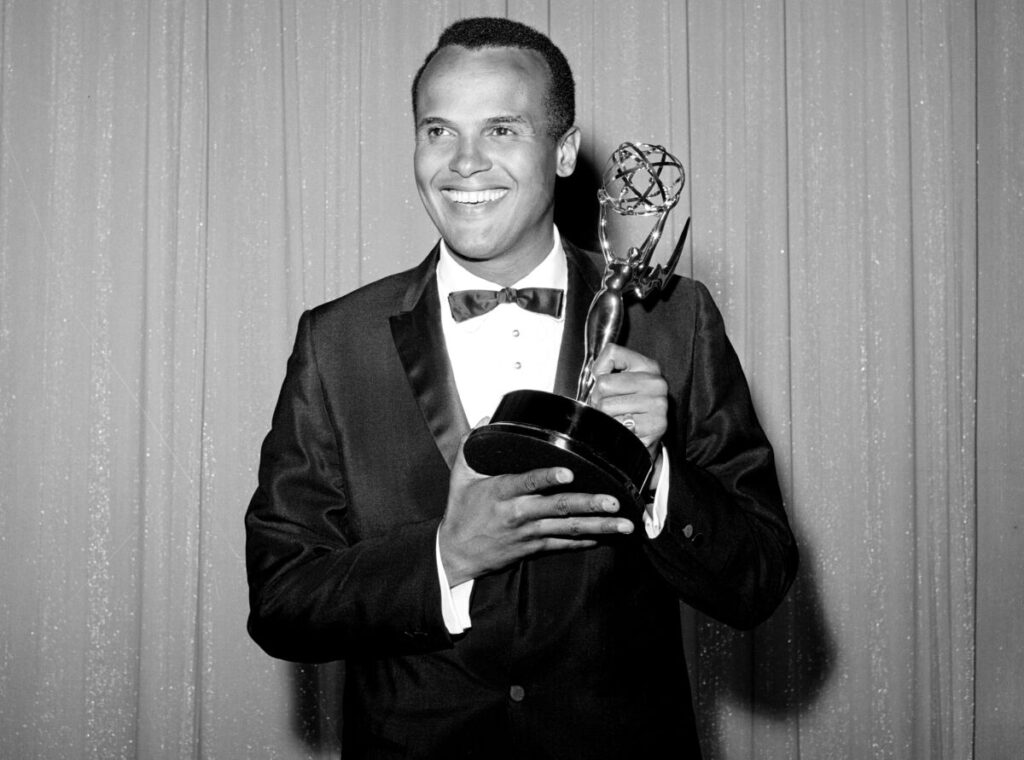
He was the first Black man to win a Tony Award on Broadway, for his interpretation of American and Caribbean folk music in the 1953 revue “John Murray Anderson’s Almanac.” Six years later, he was the first African American producer to receive an Emmy Award, for “Tonight With Belafonte,” a CBS special that presented a history of Black American life through music.
Foremost, he was a recording star. His 1956 album “Calypso” sold more than 1 million copies making him a brief rival to Elvis Presley on the pop music chart and generating worldwide interest in Caribbean-flavored music.
“There had never before been any singer that popular with White middle-class audiences as well as Black audiences,” the cultural critic and scholar Henry Louis Gates Jr. said in an interview. “In that sense, he was an agent of change, the musical voice of civil rights.”
Using music to espouse universal brotherhood, Mr. Belafonte encouraged audiences to sing along to calypso, protest and chain-gang songs, the ballad “Danny Boy” and the Hebrew folk song “Hava Nagila.”
His voice, while classically untrained, was deeply affecting and capable of great range. A Time magazine critic noted that it “can become gutty as a trumpet, musky with melancholy, or high and tremulous as a flute. It may take on the high, clipped inflection of the West Indies, the open-throated drawl of the bayou country, the softly rounded burr of the Scotch borderland.”
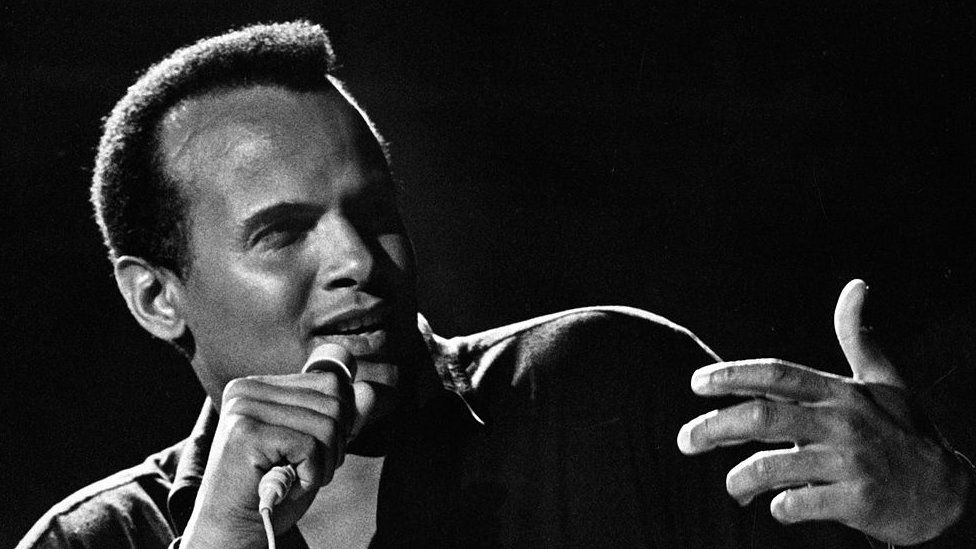
In a testament to his drawing power, Mr. Belafonte was tapped in 1968 as the first Black fill-in host for Johnny Carson on NBC’s “The Tonight Show,” the country’s highest-rated late-night talk program. Mr. Belafonte used the platform not only to entertain but also to discuss civil rights, the Vietnam War and starvation in Appalachia with guests including King and presidential candidate Robert F. Kennedy.
That same year, Mr. Belafonte and White British singer Petula Clark were performing a duet of the antiwar song “On the Path of Glory” on an NBC special. An advertising manager for the automaker Chrysler-Plymouth, which was sponsoring the show, objected when Clark spontaneously touched Mr. Belafonte’s arm.
The executive, who interrupted the song and had called for a retake, was later reprimanded by Chrysler and called Mr. Belafonte to apologize. “Your apology comes 100 years too late,” the singer replied. NBC kept the scene when the show was televised. Mr. Belafonte later told an interviewer, “It is essential to television and industries to know that people like [this] exist. I’m tired and frustrated by what I’ve had to go through in this medium.”
Alliance With King
Mr. Belafonte met King in 1956 when the then-obscure preacher called and invited the entertainer to hear him speak at Harlem’s Abyssinian Baptist Church. Mr. Belafonte, who was two years older than King, said he was “rocked” by the sermon and thereafter spoke of King as a transformative figure in his life.
“I wasn’t nonviolent by nature or if I was, growing up on Harlem’s streets had knocked it out of me — so for some time, I would view nonviolence more as a shrewd organizing tactic than anything else,” he wrote in his 2011 memoir, “My Song,” written with Michael Shnayerson.
“As I got to know Martin better, and saw nonviolence put to the test, I would come to appreciate its spiritual and emotional value,” he added. “I’d find I wanted to live by those values myself, both to help the movement and to wash away my personal anger.”
As one of King’s leading benefactors, Mr. Belafonte used his friendships with Frank Sinatra, Marlon Brando, Lena Horne and Henry Fonda to raise more than $100,000 to fund the Freedom Rides in 1964 that challenged racial segregation in interstate transportation.
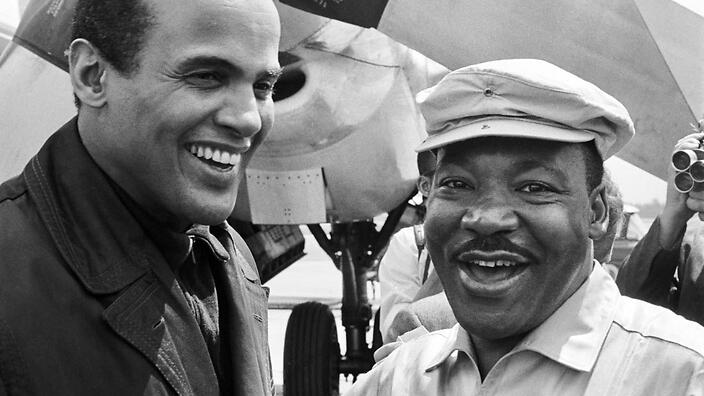
He also brought Brando, Charlton Heston, Paul Newman and Tony Bennett to the 1963 March on Washington, where King delivered his “I Have a Dream” speech a critical show of White support that made King’s address all the more universal in its appeal.
As one of the highest-paid entertainers in show business, Mr. Belafonte raised large amounts of money fast to bail civil rights leaders and rank-and-file protesters out of Southern jails. During the Kennedy and Johnson administrations, his 23-room mansion on Manhattan’s West End Avenue was used by movement leaders and Justice Department officials as a private place to air grievances with one another. It also was where older and younger members of the movement, as well as its nonviolent and militant wings, brokered truces.
“At pivotal moments, he was one of the most critical supporters of the civil rights movement,” said Taylor Branch, a Pulitzer Prize-winning civil rights historian. “Harry was a strong force for keeping people on an even keel.”
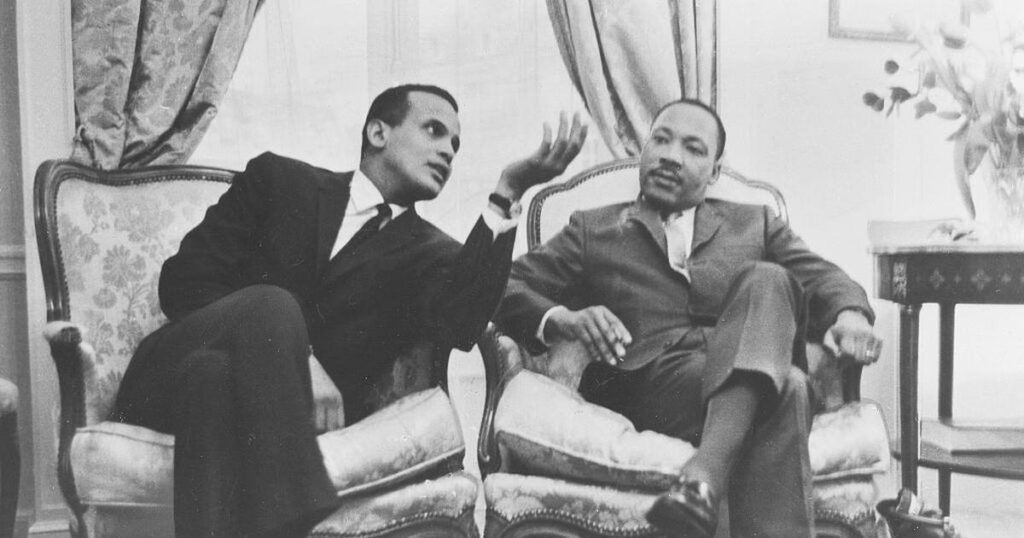
After King’s assassination in 1968, Mr. Belafonte became a roving humanitarian without portfolio. He helped start TransAfrica, a lobbying group that pressed for economic sanctions against South Africa’s apartheid regime. He lobbied for the release of Nelson Mandela and then helped coordinate the future South African president’s first visit to the United States after his liberation in 1990.
A driving force behind “We Are the World,” Mr. Belafonte gave the musical spotlight to performers such as Michael Jackson and Lionel Richie and relegated himself to the all-star chorus. The project raised tens of millions of dollars for medical and food supplies, and Mr. Belafonte participated in the arduous mission to deliver those items to relief workers in Sudan and Ethiopia.
After entertainer Danny Kaye’s death in 1987, Mr. Belafonte became the second American to be awarded the title “goodwill ambassador” for UNICEF, the United Nations Children’s Fund. He used the position to unite artists and intellectuals in Africa to focus on concerns such as hunger, polio and malaria.
‘Defined’ by poverty
Harold George Belanfanti Jr. was born in Manhattan on March 1, 1927. His father, whom Harry later recalled as hard-drinking, abusive and philandering, was often away working as a cook on “banana boats” between New York and Caribbean ports of call.
His mother, the former Melvine Love, was left to care for Harry and a younger son, Dennis. She overstayed her visa and changed her surname, eventually to Belafonte, to evade immigration authorities. She also made attempts to pass herself and her children off as Spanish or French as they moved from barrio to barrio, living what Mr. Belafonte would call an “underground life.”
His mother, who periodically found work as a cook, tried to take her son along on jobs to eat leftovers. Poverty “defined” him, he wrote in his memoir.
A self-described “angry misfit,” he said he probably had undiagnosed dyslexia. He quit formal education in the ninth grade, spending his days running with gangs. He also went to the movies.
Watching the World War II propaganda film “Sahara” (1943), Mr. Belafonte was awestruck by the scene in which Rex Ingram, a Black actor playing a Sudanese soldier, suffocates a Nazi officer by shoving his face into the North African sand. The “scene of revenge was galvanizing,” he wrote. “I’d never seen a film that showed a black character so heroic.”
A day after his 17th birthday, he enlisted in the Navy and soon was disabused of romantic notions of military fellowship. Minor infractions landed him for two weeks at the Naval Prison in Portsmouth, Va., where he saw German POWs receiving better treatment. “The injustice of this sickened me,” he wrote, adding that the experience “radicalized” him politically.
After his 18-month Navy hitch, he found work as a janitor in a Harlem apartment building, where a grateful tenant gave him tickets to the American Negro Theatre. He had never before seen a play. The actors, he wrote, were “so poised and confident, they radiated a power that felt spiritual to me.”
He began volunteering at the theater, slowly earning small parts and befriending another budding performer, Sidney Poitier, who shared Mr. Belafonte’s impoverished West Indian background. With few theatrical prospects as a Black actor, Mr. Belafonte spent much of his time putting on agitprop plays in union halls.
Sidney Poitier, first Black man to win Oscar for best actor, dies at 94
He had an unmemorable but lucrative stint as a pop crooner in 1949 and 1950, earning money he desperately needed to support his growing family. He quit after an engagement in Miami, where, he wrote, White women winked at him from the front row. “As long as I was onstage, crooning love songs, I had a certain power over them,” he wrote. “But when the lights came up, I was just another colored man hotfooting it back to Colored Town or else.”
In the meantime, he found a mentor in the African American entertainer Paul Robeson, a leading activist for civil and union rights who was hounded by federal authorities for his alleged socialist sympathies. Urged by Robeson, Mr. Belafonte began using folk songs to decry racism, poverty and other social ills.
Mr. Belafonte surged to fame with “Calypso,” which refashioned Caribbean island melodies for American listeners. The album included many of the songs with which he would forever be identified: “The Banana Boat Song,” the ballad “Jamaica Farewell,” “Come Back Liza” and “Man Smart (Woman Smarter).”
His live recording “Belafonte at Carnegie Hall” (1959), which highlighted folk music from around the globe, was a commercial and artistic triumph that stayed on the Billboard Top 10 chart for more than three years.
Mr. Belafonte won Grammy Awards for his folk recordings “Swing Dat Hammer” (1960), “At Home and Abroad” (1961) and “An Evening With Belafonte/Makeba” (1965), the last starring his protégé, the South African singer Miriam Makeba. His 1962 album “The Midnight Special” provided a career boost to a young harmonica player, Bob Dylan, then making one of his first recordings.
“He could play to a packed house at Carnegie Hall one night and then the next day he might appear at a garment center union rally,” Dylan wrote in a memoir, “Chronicles: Volume One.” “To Harry, it didn’t make any difference. People were people. He had ideals and made you feel you’re part of the human race. There never was a performer who crossed so many lines as Harry.”
“You know,” Dylan added, “he never took the easy path, though he could have.”
‘A lone voice’
For much of Hollywood’s history, Black people were presented on-screen, if at all, in demeaning, stereotyped roles or in isolated song-and-dance segments that could be scissored by theater owners in the South.
As Poitier began his Hollywood rise in the 1950s playing men of refinement and professional aspiration, Mr. Belafonte launched a film legacy that was far different.
He made his film debut in “Bright Road” (1953), in the role of a school principal opposite a teacher played by Dorothy Dandridge. They were reunited in “Carmen Jones” (1954), with Mr. Belafonte as a GI who falls for a temptress. The studio had opera singers LeVern Hutcherson and Marilyn Horne, respectively dub their voices.
There was a stiffness to Mr. Belafonte’s early, untrained movie performances, and he admitted he was self-conscious in matinee idol roles.
Mr. Belafonte, whose second and third marriages were to White women, also was unsatisfied making films because he felt movie studios did not go far enough in presenting interracial love in a realistic way.
He noted that while the heat may have been palpable on-screen with Fontaine and with Inger Stevens in the doomsday drama “The World, the Flesh and the Devil” (1959) audiences saw no kissing. That decision by studio chiefs outraged Mr. Belafonte.
After the commercial failure of “Odds Against Tomorrow” (1959), a taut bank heist and race-relations drama he starred in and co-produced, he exiled himself from movies for more than a decade.
In his memoir, Mr. Belafonte said he regularly turned down roles that seemed “neutered” of sex and rage the qualities that for him marked an interior life. The roles he declined included what became Poitier’s Oscar-winning performance as a drifter in the Southwest who helps a group of German nuns in “Lilies of the Field” (1963), and Poitier’s turn as a teacher who comes to the aid of unruly students in “To Sir, With Love” (1967).
“To Hollywood, Sidney was the one black actor with whom white America felt comfortable, because of that dignity he radiated, that sexless gallantry,” Mr. Belafonte wrote in his autobiography. “It really burned me that in the midst of the civil rights movement, with Jim Crow laws falling away, the only black who sold movie tickets was one who posed no threat whatsoever to the masculinity of white moviegoers.”
In a sporadic film career, Mr. Belafonte’s finest performance was widely thought to be the ruthless gangland leader in Robert Altman’s drama “Kansas City” (1996). The performance, which he said he based on the rougher edges of his upbringing, won the New York Film Critics Circle Award for best supporting actor.
The scope of Mr. Belafonte’s work earned him the National Medal of Arts in 1994, the Kennedy Center Honors in 1989 and awards for lifetime achievement from the NAACP and the Grammys. In 2014, he received the Jean Hersholt Humanitarian Award from the Academy of Motion Picture Arts and Sciences.
Gates, the scholar, called him “a link and a remnant of the fiery commitment of the old radical left,” adding that Mr. Belafonte “sees himself as a lone voice” championing causes left behind by the Black upwardly mobile establishment.
His uncompromising manner strained or ended once-close friendships with Poitier and Bill Cosby. He also drifted away from King’s family members, criticizing them as being more interested in profiting from the civil rights leader’s legacy than in using his stature to advance causes such as poverty reduction and labor rights.
His first marriage, to Marguerite Byrd, ended in divorce in 1957. That same year, he wed Julie Robinson, who was of Russian Jewish ancestry and had been a dancer in the otherwise all-Black Katherine Dunham Dance Company. After they divorced in 2008, Mr. Belafonte married Pamela Frank, a photographer who had been involved in his activist projects.
In addition to his wife, survivors include two daughters from his first marriage, the actress and model Shari Belafonte and Adrienne Biesemeyer; two children from his second marriage, the actress Gina Belafonte and David Belafonte; two stepchildren, Sarah Frank and Lindsey Frank; and eight grandchildren.
Having fought his way up from poverty, Mr. Belafonte was determined to leave his mark his voice sometimes at personal and professional cost. “I’m a driven man,” he once told the London Guardian. “Driven by ego, driven by conscience, always looking for another song.”
About Author