
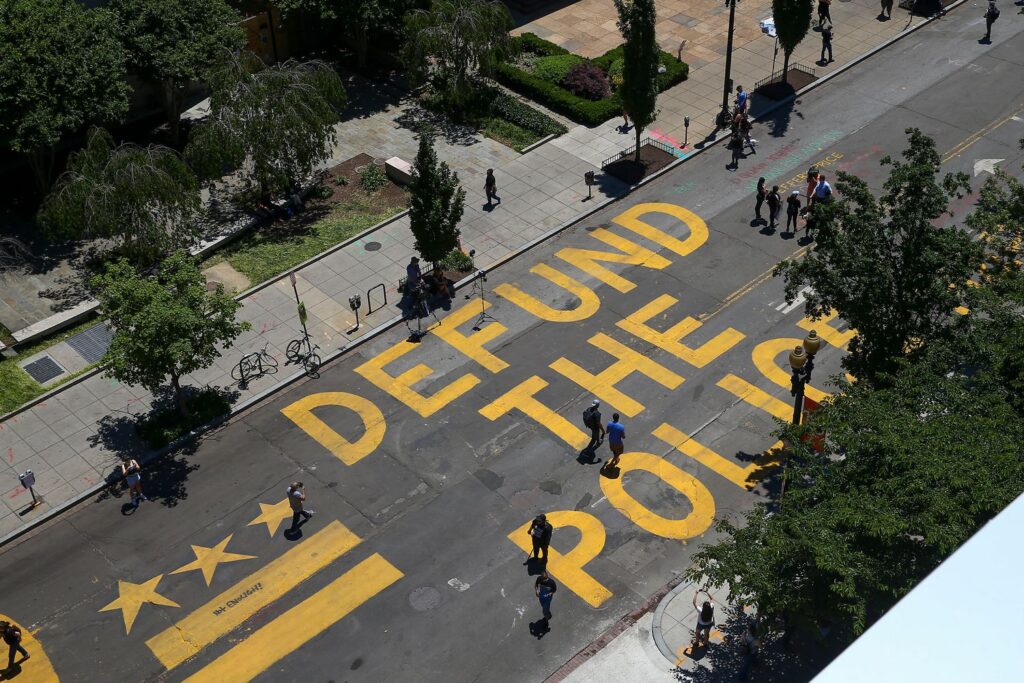
Three Years After #DefundThePolice, Schools Are Bringing Cops Back to Campus
by MAYA POTTIGER, Word In Black
This story is part of “All Those ‘Racial Reckoning’ Promises,” Word In Black’s series exploring the pledges made to the Black community following the Summer of George Floyd and what organizations and leaders can still do now to promote racial equity and justice.
In the wake of George Floyd’s murder, calls to defund the police rang across the nation during the summer of 2020. While few cities took swift action, many school districts integral community hubs where young minds are nurtured, and where kids spend the bulk of their time began to reevaluate the presence of armed personnel patrolling the hallways.
In September 2019, eight months before Floyd’s murder, the Bureau of Justice Statistics reported nearly 25,000 school resource officers were assigned to primarily K-12 schools.
Those numbers slowly started to change in districts around the country as a response to calls to defund the police.
In Washington, D.C., for example, the D.C. Council unanimously voted in 2021 to reduce the number of SROs in both public and charter schools beginning July 2022, with the plan to end the Metropolitan Police Department’s School Safety Division in 2025.
In September 2019, eight months before Floyd’s murder, the Bureau of Justice Statistics reported nearly 25,000 school resource officers were assigned to primarily K-12 schools.
As of January 2023, there were about 60 SROs remaining in D.C. schools, down from its peak of more than 100, according to the Washington Post. However, the progress made toward reducing law enforcement presence in D.C. schools appears to be in jeopardy. In what seems like a backtrack from the progressive momentum generated during “America’s racial reckoning,” four D.C. council members now support a proposal to retain officers in schools, citing an uptick in violence and crime in school vicinities.
On the other side of the country, the Denver Public School District Board of Education unanimously voted to bring SROs back to schools through June 2023. Similar to D.C., the decision followed closely on the heels of a shooting at Denver’s East High School. And 18 SROs were brought back to 17 schools in the district.
Schools around the country are running into roadblocks trying to remove SROs.
The Roadblocks
The roadblocks don’t look the same in every situation.
In D.C., for example, ACLU DC policy associate Ahoefa Ananouko cites Mayor Muriel Bowser as the biggest barrier. Bowser has been vocal about keeping SROs in schools, going as far as to say that removing SROs is “the nuttiest thing.”
And, like in D.C. and Denver, politicians, policymakers, and some educators nationwide cite violence in the area as a reason for keeping SROs, but there is little evidence to support that SROs actually do make schools safer. In fact, in a 2020 report, the Justice Policy Institute said, “rates of youth violence were plummeting independent of law enforcement interventions, and the impact of SROs on school shootings has been dubious at best.”
Plus, it’s been proven that SROs exacerbate the school-to-prison pipeline, especially for Black students.
The Center for Public Integrity analyzed U.S. Department of Education data from all 50 states, D.C., and Puerto Rico in 2021. The investigation found that school policing disproportionately affects students with disabilities and Black students. Nationwide, these two groups were referred to law enforcement at “nearly twice their share of the overall student population.”
What we often have seen is that the teachers or classified staff who feel that it’s not within their ability to handle certain situations automatically defer to the SROs.ADONAI MACK, SENIOR DIRECTOR OF EDUCATION AT CHILDREN NOW
But it doesn’t stop many adults on the school campus from differing discipline to SROs, says Adonai Mack, the senior director of education at Children Now. This happens when there is either a fear around addressing disciplinary problems or concerns, or feeling they aren’t able to handle it.
“What we often have seen is that the teachers or classified staff who feel that it’s not within their ability to handle certain situations automatically defer to the SROs,” Mack says.
This is where the call for additional non-police safety officials comes in, like nurses, counselors, or psychologists, who “certainly do more help than harm,” Mack says.
But, like teachers and other educators, there’s a shortage of these professionals. But Ananouko says this shouldn’t be a barrier if policymakers decided it was more important to have mental health professionals or restorative justice interventionalists — people who are trained to handle trauma, behavior, and underlying issues.
“I believe they could and should shift those resources to incentivize those professionals being hired instead of investing more in police,” Ananouko says, “which have been shown to be harmful to students in a school environment, generally.”
A Detriment to Mental Wellness
Though it’s too early to have concrete data on students’ mental health without SROs, there are, anecdotally, reasons to believe it’s a positive change.
Aside from students leading police-free school groups, there are other historic factors that lend insight. For one, whenever there are fears around deportation, not only Black students, but Latino and AAPI students experience negative mental health impacts, Mack says.
The feelings, like with the Defund the Police movement, are split across racial lines. Black, Latino, and AAPI students don’t always feel safe with police around.
“With kids of color, what you often have is this alienation,” Mack says. “There are decreased feelings of safety. Now, I would say that’s different for white kids and white families. They often will feel that having police on campus makes the campus safer.”
Black and Brown students are more likely to attend a school patrolled by an SRO.
And, Black and Brown students are more likely to attend a school patrolled by an SRO. A 2023 Urban Institute study found that schools where the student population is at least 80% Black and Brown, students are more likely to have an SRO compared to schools with a high population of white students, regardless of income levels. And, 34%-37% of schools with high populations of Black and Brown students have an SRO, compared to 5%-11% of predominantly white schools.
But it’s clear that there’s “a detriment to kids of color” with police on campus, Mack says.
“From that perspective, with any decrease, what we see is that it automatically improves the mental wellness of students from those communities,” Mack says.
‘A Critical Point’
While the roadblocks might be tougher or the headlines have fizzled out, Ananouko says the police-free schools movement “isn’t slowing down at all.”
And now, D.C. is at a critical point. It’s budget oversight season, meaning it’s the time when funding for SROs could be restored. But, every year since the initial 2021 vote, students, school administrators, teachers, and advocates have continued to push for the phase-out, Ananouko says.
“Our messaging has not changed,” Ananouko says. “We’ve stayed consistent in saying that police don’t keep students safe. And none of that has changed in these past three years.”
The bottom line is that all kids deserve to feel safe and nurtured, Ananouko says.
“They should be able to feel like they can go to school with that fear,” she says, whether this fear comes from other students or armed officers in the building who can use their gun “at any point at the discretion of the law is on their side.”
“A lot of the issues that students are dealing with are not going to be addressed by somebody with a gun.”
About Author