
Schools say dress codes promote discipline. But many Black students see traces of racism
by CHEYANNE MUMPHREY AP Education Writer
For as long as schools have policed hairstyles as part of their dress codes, some students have seen the rules as attempts to deny their cultural and religious identities.
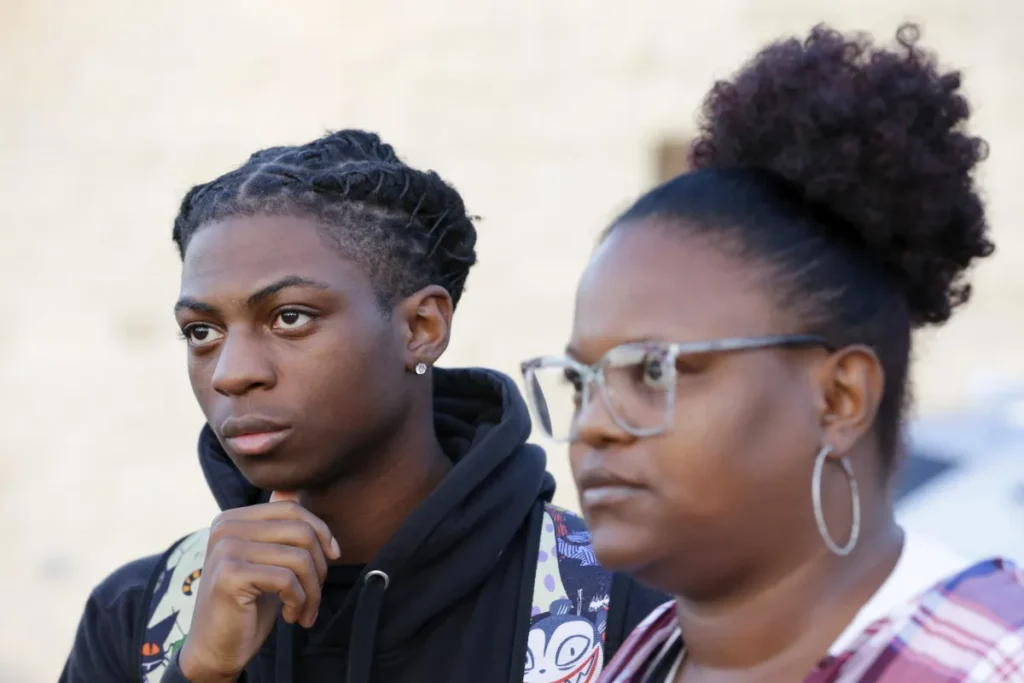
Nowhere have school rules on hair been a bigger flashpoint than in Texas, where a trial this week is set to determine whether high school administrators can continue punishing a Black teenager for refusing to cut his hair. The 18-year-old student, Darryl George, who wears his hair in locs tied atop his head, has been kept out of his classroom since the start of the school year.
To school administrators, strict dress codes can be tools for promoting uniformity and discipline. But advocates say the codes disproportionately affect students of color and the punishments disrupt learning. Under pressure, many schools in Texas have removed boys-only hair length rules, while hundreds of districts maintain hair restrictions written into their dress codes.
Schools that enforce strict dress codes have higher rates of punishment that take students away from learning, such as suspensions and expulsions, according to an October 2022 report from the Government Accountability Office. The report called on the U.S. Department of Education to provide resources to help schools design more equitable dress codes.
In stringent public school dress codes, some see vestiges of racist efforts to control the appearance of Black people dating back to slavery. In the 1700s, South Carolina’s “Negro Act” made it illegal for Black people to dress “above their condition.” Long after slavery was abolished, Black Americans were still stigmatized for not adopting grooming habits that fit white, European beauty standards and norms.
Braids and other hairstyles carry cultural significance for many African Americans. They served as methods of communication across African societies, including to identify tribal affiliation or marriage status, and as clues to safety and freedom for those who were captured and enslaved, historians say.
Black Americans have a variety of hair textures that can require chemicals, time and equipment to style or make straight. Some common natural styles include afros, braids, cornrows or locs. But many have felt pressure to straighten curly hair or keep it cut short.
Whether in professional workplaces, social clubs or schools, research has shown that such beauty norms and grooming standards have inflicted physical, psychological and economic harm on Black people and other people of color.
Dress codes are built upon regulations that stretch back decades, which explains why they often are complex, said Courtney Mauldin, a professor at Syracuse University’s School of Education.
“Schools were not designed with Black children in mind,” she said. “Our forefathers of education were all white men who set the tone for what schools would be … and what the purposes are of schooling — one of those being conformity. That’s one of the key ideas that was actually introduced in the 1800s.”
In some cases, students and advocates have pushed back successfully.
In 2017, then-15-year-old Black twins, Deanna and Mya Cook, were punished for wearing box braids with extensions at their charter school in Malden, Massachusetts. The sisters were told their hair did not comply with the school dress code. The American Civil Liberties Union of Massachusetts filed a complaint, and the state attorney general said the school policies against extensions and other hairstyles appeared to violate racial discrimination laws.
“You don’t expect to get in trouble for your hair,” said Mya Cook, now 22 and a recent graduate from University of Massachusetts Dartmouth. “But we see it happen. Administrators are able to retaliate against students and use that as a form of control and oppression. And since there’s no policy in place, they’re able to get away with it.”
Schools with higher percentages of Black and Hispanic students are more likely to enforce strict dress codes, and schools in the South are twice as likely to enforce strict dress codes as those in the Northeast, according to the GAO report. In the sub region including Texas, Oklahoma, Arkansas and Louisiana, 71% of public schools have strict dress codes the highest in the country, the report said.
School districts have argued that strict dress codes increase academic performance, encourage discipline and good hygiene and help to limit distractions.
At Barbers Hill High School in Mont Belvieu, Texas, where Darryl George is a junior, Superintendent Greg Poole has compared the district’s grooming policies to military practices. In a full-page advertisement in the Houston Chronicle last month, Poole said service members “realize being an American requires conformity with the positive benefit of unity, and being part of something bigger than yourself.”
George has been serving either in-school suspension or spending time at an off-site disciplinary program since the end of August. His family was denied a religious exemption and has argued his locs have cultural significance.
George’s family has also filed a formal complaint with the Texas Education Agency and a federal civil rights lawsuit against Gov. Greg Abbott and Attorney General Ken Paxton, along with the school district. The lawsuits allege the state and district failed to enforce the CROWN Act, which prohibits race-based hair discrimination and took effect in Texas in September.
Asking students to change how they wear their hair for the sake of uniformity is a proxy for racism, said U.S. Rep Bonnie Watson Coleman, a New Jersey Democrat who has championed the CROWN Act.
“To be confronted with this unnecessary discrimination, which has nothing to do with your ability to learn, has nothing to do with your ability to sit in a classroom, has nothing to do with your ability to thrive academically, is wrong,” she said.
In 2020, the same high school told a Black male student that he had to cut his dreadlocks to return to school or participate in graduation. In recent years several other Texas high schools have told Black students their hair violated dress code policies. The ACLU has filed lawsuits in a couple cases, including against Magnolia Independent School District, which ultimately ended up removing their hair restrictions from the dress code.
In 2020, the ACLU of Texas identified 477 school districts with boys-only hair length rules. Since then, half have removed the restrictions from their policies, according to an ACLU report. It argues for more equitable dress codes, noting Black students are more likely to face disciplinary action.
Hair length rules applying to boys at Texas schools also unfairly target transgender and non-binary students, said Chloe Kempf, an attorney at the ACLU of Texas.
The trial Thursday is being held in state court in Anahuac, Texas, to decide whether George’s high school is violating the CROWN Act through dress code restrictions limiting the length of boys’ hair. The decision is expected to set precedent in a state where several districts have similar policies.
About Author