
Black Texas student punished for his hair in locs gets Feb. 22 trial date
by JUAN A. LOZANO Associated Press
A judge ordered Wednesday that a trial be held next month to determine whether a Black high school student in Texas can continue being punished by his district for refusing to change a hairstyle he and his family say is protected by a new state law.
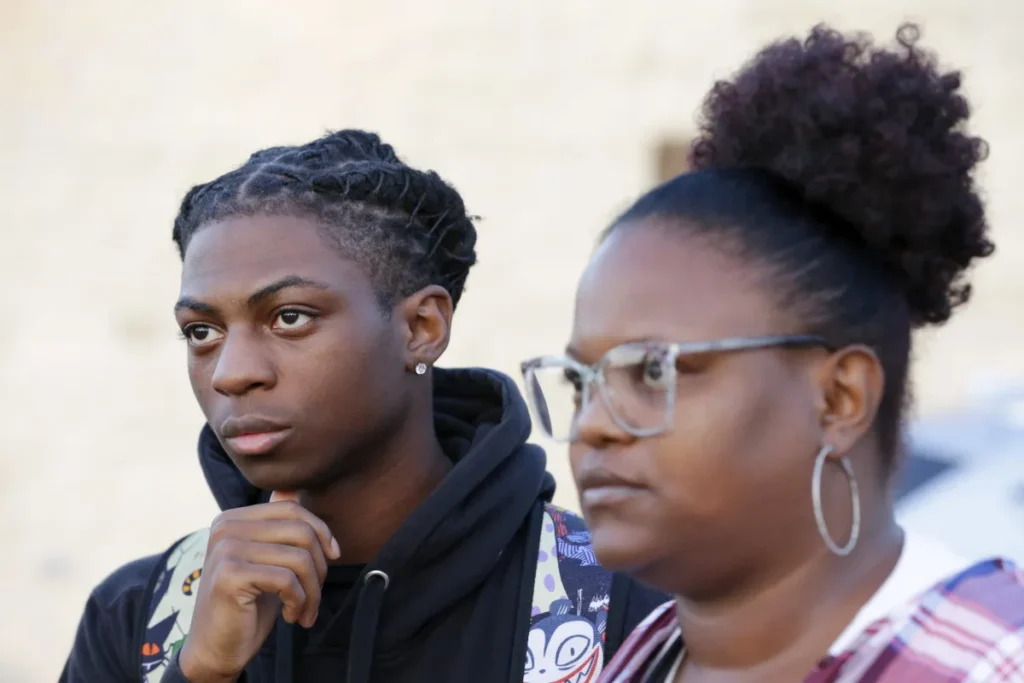
Darryl George, 18, has not been in his regular classroom in Barbers Hill High School in Mont Belvieu since Aug. 31. Instead, he has either been serving in-school suspension or spending time in an off-site disciplinary program.
His Houston-area school district, Barbers Hill, has said George’s long hair, which he wears in neatly tied and twisted locs on top of his head, violates a district dress code that limits hair length for boys. The district has said other students with locs comply with the length policy.
George, a junior, said Wednesday that he has felt stress and frustration over what he sees as unfair punishment, but that he was grateful to soon be getting his day in court
“I’m glad that we are being heard, too. I’m glad that things are moving and we’re getting through this,” George said after the hearing in Anahuac, with his mother, Darresha George, standing next to him.
State District Judge Chap Cain III in Anahuac set a Feb. 22 trial in a lawsuit filed by the school district regarding whether its dress code restrictions limiting the length of boys’ hair violates the CROWN Act. The new Texas law, which took effect in September, prohibits race-based hair discrimination and bars employers and schools from penalizing people because of hair texture or protective hairstyles including Afros, braids, locs, twists or Bantu knots.
Darresha George said she was disappointed the judge did not consider granting a temporary restraining order, which would have halted her son’s punishment until next month’s trial.
“I have a son, 18 years old, that wants to go to school, that wants to get his education, and y’all messing with him. Why?” she said.
In an affidavit filed last week in support of the temporary restraining order, Darryl George said he is being subjected to “cruel treatment.”
“I love my hair, it is sacred and it is my strength,” George wrote. “All I want to do is go to school and be a model student. I am being harassed by school officials and treated like a dog.”
A spokesperson for the school district didn’t speak with reporters after the hearing and didn’t immediately reply to an email seeking comment.
In a paid ad that ran this month in the Houston Chronicle, Barbers Hill Superintendent Greg Poole maintained the district is not violating the CROWN Act.
In the ad, Poole defended his district’s policy and wrote that districts with a traditional dress code are safer and had higher academic performance and that “being an American requires conformity.”
“We will not lose sight of the main goal high standards for our students by bending to political pressure or responding to misinformed media reports. These entities have ‘lesser’ goals that ultimately harm kids,” Poole wrote.
The two Texas lawmakers who co-wrote the state’s version of the CROWN Act state Reps. Rhetta Bowers and Ron Reynolds attended Wednesday’s hearing and said the new state law does protect Darryl George’s hairstyle.
The district “is punishing Darryl George for one reason: his choice to wear his hair in a protective style which harms no one and causes no distraction in the classroom,” Bowers said.
George’s family has also filed a formal complaint with the Texas Education Agency and a federal civil rights lawsuit against Gov. Greg Abbott and Attorney General Ken Paxton, along with the school district, alleging they failed to enforce the CROWN Act. The lawsuit is before a federal judge in Galveston, Texas.
Barbers Hill’s policy on student hair was previously challenged in a May 2020 federal lawsuit filed by two other students. Both students withdrew from the high school, but one returned after a federal judge granted a temporary injunction, saying the student showed “a substantial likelihood” that his rights to free speech and to be free from racial discrimination would be violated if not allowed to return to campus. That lawsuit remains pending.
About Author